
“Connecting Through Books, Sharing Insights” August Reading Discussion

August Book Sharing Session Recap
The August Book Sharing Session arrived as scheduled, and this time we had the pleasure of inviting two senior guests who delivered wonderful presentations on "Choice" and "Psychological Nutrition." Let's now revisit the key takeaways from this intellectual feast.
"Choice: Direction is More Important Than Speed"

A Thought-Provoking Story
The importance of life choices is vividly illustrated in this story:
Two villagers went out to seek work; one planned to go to New York, the other to Washington. While waiting in the terminal, they overheard people discussing: New Yorkers are shrewd, they even charge for giving directions; Washingtonians are simple and kind, offering not just bread but also old clothes to those without food.
Hearing this, the man bound for New York thought Washington sounded better – even if you don't earn much, you won't starve. The man headed for Washington thought New York offered more opportunities – you could even earn money just by giving directions. Eventually, they met at the ticket refund counter and swapped their tickets.
The outcome was unexpected: The one who went to Washington was content with free bank water and supermarket samples, ultimately achieving little. The one who went to New York found business opportunities everywhere, from selling "potting soil" to starting a cleaning company, eventually building a successful enterprise.
Core Insights
Choices Determine Direction, Effort Determines Speed: The path we choose in life is often more important than sheer hard work alone.
Effort is the Foundation of Choice: Without effort, we might not even qualify to make certain choices.
Action Trumps Waiting: When unsure of the right choice, it's better to start acting and adjust the course along the way.
Adaptation and Transcendence: Choice is about adapting to the environment; effort is about transcending oneself.
"Psychological Nutrition: Helping Children's Lives Blossom"
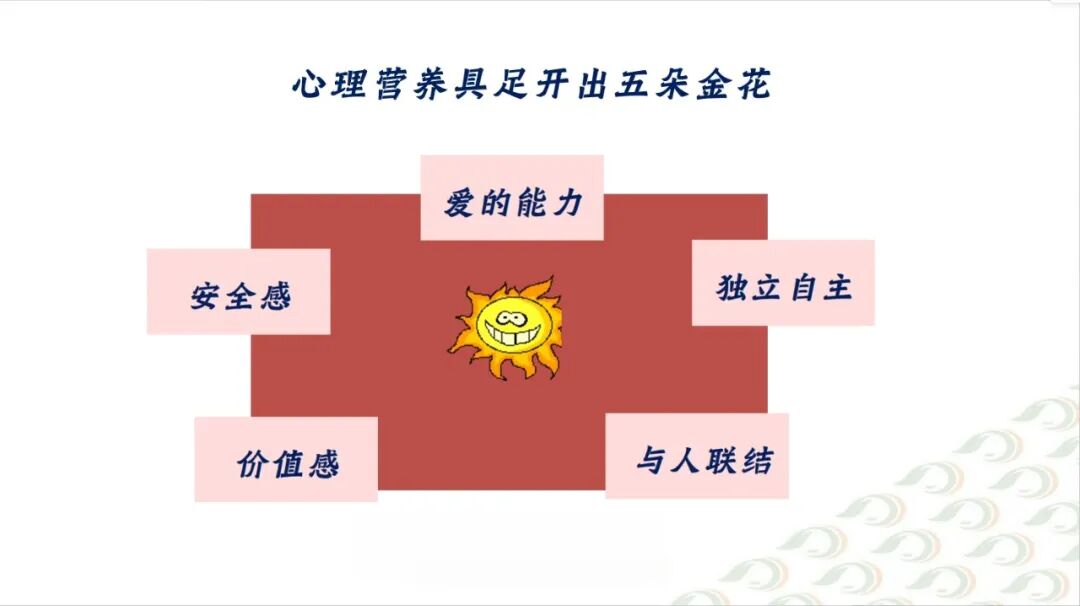
Understanding Psychological Nutrition
The value of self-growth is equally important in parent-child education. Beyond focusing on children's physical needs, we must pay greater attention to their psychological nutrition.
When exploring the value of self-growth, we recognize the importance of psychological nutrition for a child's development. Just as the body needs physical nutrients, a child's psyche requires the following five core nutrients:
Capacity for Love: Learning to give and receive love.
Sense of Security: Building trust in the world.
Independence & Autonomy: Cultivating the ability to think and act independently.
Sense of Self-Worth: Recognizing one's own value and building self-confidence.
Capacity for Connection: Developing healthy interpersonal relationships.
How to Assess if a Child is Receiving Adequate Psychological Nutrition?
We can observe three aspects:
Is their emotional state stable?
Are their interpersonal relationships harmonious?
Is their language free from self-harm or harm towards others?
The Influence of the Family Environment
The influence of the family environment should not be underestimated. If a child exhibits emotional issues or behavioral deviations, it's often a cry for help from within. In such times, the most important response isn't to blame the child, but to reflect on the environment and companionship we provide.
Parents are the most important providers of a child's psychological nutrition. In this process, the father's role is particularly crucial. Simple phrases like "I'm so happy you're my child" or "It's so wonderful to have you" can provide immense spiritual strength to a child.
Crucially, children learn how to face the world through imitation. They learn from our attitude towards problem-solving, how we manage relationships, and how we handle emotions. Therefore, how we conduct ourselves is more important than what we preach.
Remedial Measures
When a lack of psychological nutrition is identified:
Start acting immediately, regardless of the child's age.
Prioritize improving the marital relationship and the parent-child relationship.
Provide the child with ample appreciation, affirmation, and attentive listening.
Create a family environment filled with love and understanding.
Clash of Ideas: In-Depth Post-Event Exchange
Following the presentation segment, a lively interactive discussion unfolded. Colleagues shared unique insights on "Choice" and "Psychological Nutrition" based on their personal experiences.
Regarding the topic of "Choice," several colleagues shared real-life experiences from their careers. Some candidly admitted that certain seemingly chance choices ultimately became significant turning points in their professional lives. A consensus emerged from the discussion: when making choices, one should employ rational analysis while also listening to their inner voice, and persistence and effort after the choice are equally crucial.
The topic of "Psychological Nutrition" sparked even stronger resonance. Colleagues openly discussed their insights and confusions from parenting practices. One colleague remarked, "We often focus on providing material conditions but overlook the spiritual nourishment our children need most." This topic also prompted many to reflect on their own upbringing, realizing that replenishing psychological nutrition is not just for the children but also a form of healing for one's own inner self.
The most valuable part was the sharing of practical experiences: concrete methods for enhancing parent-child relationships through quality time, maintaining emotional stability amidst busy work schedules, and fostering a healthy growth environment through spousal collaboration. These practical insights provided invaluable references for all participants.